


Inside Manufacturing World Tokyo 2025: NTT DATA's Technology Showcases
From Innovation to Intelligence: NTT DATA is Shaping the Future of Smart Manufacturing
NTT DATA participated in Manufacturing World Tokyo 2025, the leading global trade show for cutting-edge manufacturing technologies, from July 9-11, 2025. Along with its group companies, NTT DATA showcased smart technologies that are not only transforming the manufacturing industry but are positively impacting society. This article spotlights our in-booth sessions at the event, featuring SMEs and clients who shared real-world use cases on AI, digital twins, automation, and more-emphasizing the impact of these technologies in solving today's manufacturing challenges.

Four SME expressing about 'Transforming the Digital Supply Chain in the New AI Era'
1. Voices from the Booth: Practical Innovation in Action
In a series of in-booth sessions, NTT DATA and its group companies addressed the complex challenges in the global manufacturing landscape ranging from supply chain disruptions and labor shortages to rising operational costs. The speakers explored how innovative technologies are being applied to solve real-world problems.
Session 1: Intelligent Manufacturing Powered by GenAI
Ranjeet Saudagar, President of Manufacturing & Commercial Industries, NTT DATA presented a comprehensive approach for tackling manufacturing challenges through seven pivotal steps: workforce transformation, sustainability, engineering, R&D, resilient supply chains, customer excellence, and product servitization. His session emphasized driving human-centric excellence in manufacturing, underpinned by GenAI and other emerging technologies.
NTT DATA is committed to powering a sustainable future through decarbonization and the adoption of Industry 5.0 technologies-ensuring long-term value creation for our clients and society.
Session 2: What's Next in Manufacturing: Global Tech Insights
Tsukasa Kouno, Deputy Manager and manufacturing expert at NTT DATA presented two forward-looking use cases that exemplify how emerging technologies are shaping factory operations across the globe.
Humanoid Robots in Factory Operations:
In a successful test conducted in November 2024, humanoid robots were deployed at a North American factory of a German automotive OEM. These robots demonstrated a four-fold increase in operational speed and a seven-fold increase in task accuracy. By replacing the human workforce with robots, the expectation is not only to enhance productivity but also worker safety by reducing the risk of labor-related injuries from demanding tasks during assembly processes (also, from tasks performed in dangerous areas like high-heat machine maintenance or in radiation areas). Although enterprises are not ready to deploy robots commercially yet, promising research is being conducted in that direction. This momentum is also reflected in NTT DATA's commitment to leveraging robotics to address workforce challenges and drive operational excellence for clients.
Digital Twin of Robotic Arm:
The second case explored the integration of a digital twin of a FANUC robot (3D model) into a real-time simulation platform developed by a major U.S. semiconductor manufacturer. This solution is under trial at an automotive OEM factory to reduce dependency on proprietary software from robotics manufacturers and their specific programming language. By enabling interoperability across different robotic systems and brands, the initiative paves the way for a unified platform that connects diverse machines on the shopfloor. This approach empowers manufacturers with greater flexibility, scalability, and control over their automation ecosystems.
Session 3: Agile Supply Chains Powered by Blended AI
Jordi Vilardaga, Head of Digital Supply Chain CoE, NTT DATA, Inc., delivered a compelling session on the transformative potential of agile supply chains powered by blended AI. With disruptions driven by geopolitical shifts, climate-related events, and labor shortages, supply chain agility has become a strategic imperative for CEOs worldwide.
Vilardaga introduced Blended AI, a holistic approach that integrates Generative AI, Agentic AI, Machine Learning, and IoT to enable predictive, rather than reactive, supply chain operations. This transformation is anchored by three pillars: high-quality data, cross-functional collaboration, and scalable digital platforms.
Real-world use cases illustrated the tangible business value of this approach:
- Smart Logistics
Manufacturers face various challenges such as unpredictable demand, manual scheduling, and inefficient material flows in logistics, leading to bottlenecks and downtime. Smart Logistics uses autonomous AI agents to continuously monitor real-time data, optimize scheduling, and automate material transfers. As a result, Smart Logistics delivers significant benefits, including minimized downtime, faster and optimized planning, improved logistics efficiency, and ensuring high availability and trust across operations. - Smart Transportation
Manufacturers struggle with transport management due to manual contract validation, inefficient scheduling, and lack of real-time delivery tracking, resulting in delays and higher costs. Smart Transportation tackles these issues by using AI to automate contract analysis, optimize shipment scheduling, and monitor deliveries in real time. Its main benefits are enhancing allocation efficiency, cost reduction, and contractual compliance. - Task Manager
Automotive manufacturers confront frequent production schedule changes, diverse suppliers, and lack of real-time stock visibility, leading to manual, time-consuming incident handling. Task Manager uses AI to automate task creation and prioritization, process alerts, unstructured data, and monitor inventory in real time. This improves efficiency, reduces manual workload, and prevents production stoppages. As a result, Task Manager delivers key benefits, including faster task processing, automated critical workflows, enhanced task visibility and clarity, and increased efficiency in inbound operations. - Shopfloor Assistant
Manufacturers encounter significant obstacles such as unplanned downtime, lack of real-time visibility, and inefficient manual escalation during equipment failures on the shopfloor. Shopfloor Assistant deploys an AI-powered virtual assistant that guides operators through troubleshooting, automates incident logging, and provides instant access to technical knowledge. As a result, Shopfloor Assistant delivers measurable benefits, including reduced downtime, improved role efficiency, faster access to technical knowledge, complete traceability, scalability, and standardization across sites.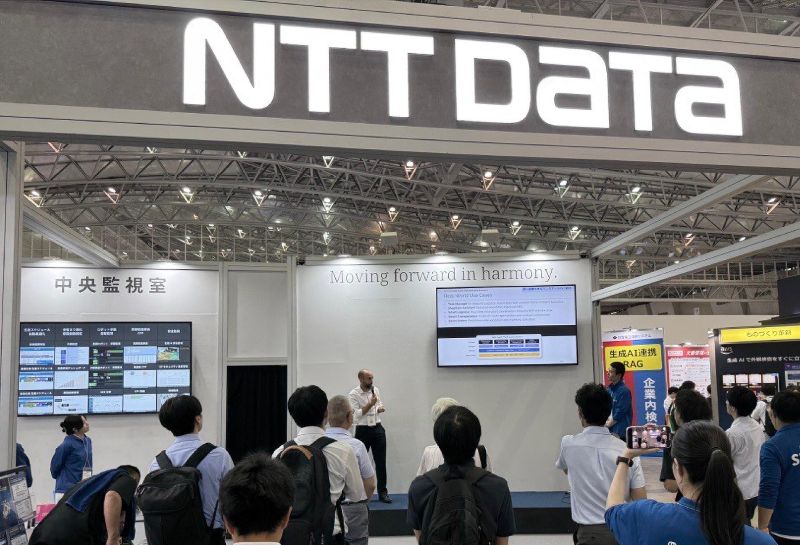
Jordi speaking about 'Agile Supply Chain by Blended AI'
Session 4: A Case of Lights-Out Factory
Karine Yan, Partner Success Manager, NTT DATA Taiwan, presented two initiatives that demonstrated the power of intelligent automation in achieving lights-out manufacturing-where factories operate autonomously with minimal human intervention.
Case Studies in Intelligent Manufacturing
Karine discussed real-world implementations of Automated Guided Vehicles (AGVs) and the Manufacturing Execution System (MES), NTT DATA's Excellent MES (EXC-MES), at a Taiwanese manufacturer responding to market volatility and rising customization demands. Faced with the need for rapid mass production and efficient resource management, the company partnered with NTT DATA to drive digital transformation.
The deployment of AGVs and EXC-MES enabled real-time data monitoring, seamless integration with MES and ERP systems, and optimized logistics coordination. The results were significant: a 33% increase in transportation efficiency and an 83% reduction in transportation personnel costs, underscoring the impact of automation on operational performance and cost savings.
NTT DATA's Global Intelligent Manufacturing Service:
Karine also introduced NTT DATA's comprehensive suite of intelligent manufacturing solutions, designed to support global clients in their digital transformation journeys.
- Excellent MES (EXC-MES): Serves as the central hub for managing the entire manufacturing process and integrating smart factory applications.
- EAP/IIoT Equipment Automation Program: Enables real-time monitoring of Overall Equipment Effectiveness (OEE) and facilitates data analysis.
- Data Platform: Eliminates data silos to create a unified data environment accessible across enterprise applications.
- Excellent WMS (EXC-WMS), our Warehouse Management System (WMS): Manages receiving and shipping, material handling, inventory transfers, and stocktaking efficiently.
- AGV/AMR Automation System Integration Solution: Connects AGVs across platforms, providing real-time analytics through visual dashboards.
- Enterprise Decision-Making Support Platform: Unifies information flows from multiple platforms and empowers leadership with real-time decision intelligence through visual dashboards and reports.
2. Continue the Conversation
Couldn't attend Manufacturing World Tokyo? There's more to explore.
Dive deeper into our latest insights and innovations:
- Download our whitepaper Agile Supply Chain Powered by Blended AI (PDF: 4.4MB) to learn how blended AI is transforming supply chain operations.
- For more insights and resources on how NTT DATA is reengineering manufacturing, follow: Smart Manufacturing
Speakers

Ranjeet Saudagar
President of Manufacturing & Commercial Industries, NTT DATA

Tsukasa Kouno
Deputy Manager and manufacturing expert at NTT DATA

Jordi Vilardaga
Head of Digital Supply Chain CoE, NTT DATA, Inc.

Karine Yan
Partner Success Manager, NTT DATA Taiwan

Sunil Gautam (Editor)
Associate Manager, Global Industries, Global Marketing and Communication