


Simulation of people changing with digital personas
In a rapidly changing market environment, deeply understanding the values and behaviors of customers and individuals has become a paramount issue common to all companies. However, conventional surveys such as questionnaires, focus group interviews, and test marketing cannot capture complex and diverse customer psychology due to time, cost, and scope limitations. To address these issues, NTT DATA has developed the Social Simulation Platform, which enables dialogue and discussion with virtual persons who behave like real customers using digital persona technology using generative AI. This article introduces the mechanism, value, use cases, and prospects.
1. AI-generated Personas
In recent years, accurately simulating human behavior and thinking has become increasingly important for improving customer understanding and service development. However, conventional surveys, focus group interviews, and test marketing have limitations in cost, speed, and coverage, making it difficult to grasp complex and emergent customer behavior.
The using the strengths of AI-generated Persona developed by NTTDATA is a new approach to overcome this challenge.
A persona is a digital representation of a customer that is generated by integrating various types of information such as demographic attributes, psychological characteristics, behavioral tendencies, and interests.
With AI technology, these personas are not just static profiles but can interact in natural language and behave like real people, maintaining consistent ideas and values across different situations.
This makes it possible to simulate realistic reactions, discussions, and opinion formation just like real customers or individuals.
2. Data required to create a digital persona
A digital persona is constructed based on the following multifaceted data:
- Demographic data (Age, gender, region, etc.)
- Psychological characteristics (Values, preferences, and interests)
- Behavioral data (Purchasing behavior, brand contact history)
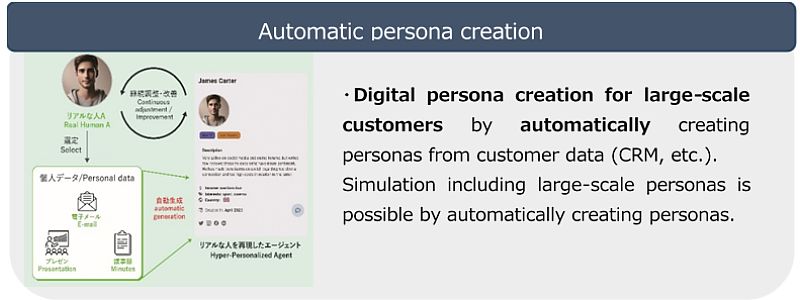
- CRM and customer databases
- Minutes and presentation materials
- Web/SNS information
- Results of past customer surveys
By combining actual data obtained from CRM, etc. and external information according to user's needs, digital personas can automatically be generated to create models closer to real customers and people.
3. When to Use Digital Persona Technology
Digital persona technology can be used in a wide range of business areas by simulating persona interaction and persona-to-person interaction, including
- Marketing Strategy Planning
Simulating responses from target audiences prior to campaigns to optimize message and creative content - Product Development
Evaluating customer evaluations of new product features and design in advance to identify areas for improvement - Sales Proposals
Identifying needs for each customer segment and personalizing proposals - Human Resources and Organizational Development
Reducing risks by predicting employee responses and the impact of organizational change - Education and training
Practicing how to react to customers and crisis management scenarios in a virtual environment - Executive AI
Executive-level discussions on pre-reviews, wall cutting, organizational change, strategy development, and investment decisions - Customized content generation
Using digital personas that represent target audiences to generate content tailored to preferences, behaviors, and communication styles
As these applications become more widespread, companies will be able to better understand customer reaction and de-risk decisions before they go to market.
Business operations will become more simulation-driven, as digitally created personas of customers, employees, and even executives make decisions in a virtual space.
As a result, we realize "future-oriented management" that enables us to quickly search for optimal solutions before testing them in the real world, from product planning to organizational management and strategy planning.

4. NTT DATA's approach to digital personas
At NTT DATA, the Innovation Center Italy team has developed the Social Simulation Platform (SSP), a platform for advanced simulations that integrates generative AI persona technology, and has started to deploy it primarily overseas. The main features and functions of SSP are as follows:
1. Digital persona management
Multiple personas can be confirmed from a list screen, and individual characteristics, behavioral tendencies, and opinion tendencies can be viewed in ID card format.
2. Chat function
Users can interact with each persona one-on-one, and can have natural conversations, ask questions in Japanese and English, and check responses by attaching product/design images, PDFs, and PowerPoint documents.
3. Focus group settings
Focus groups are a function that enables multiple digital personas to automatically engage in discussions and generate natural mutual responses. Generated AI can reproduce traditional face-to-face focus groups to gain deeper customer insights faster and at a lower cost.
4. Focus group analysis
The results of focus group discussions can be reviewed and analyzed from the following perspectives. AI agents manage the progress and automatically summarize the main points of the discussion and suggest improvements.
- Discussion improvement summary
- Opinion summary for each persona
- Suggestions for improvement
- Actual conversation logs
5. Dashboard
Dashboard is a capability for automatically analyzing and visualizing interview results and chat contents with personas. In addition to displaying logs, it combines text understanding, emotion estimation, and key point extraction by generative AI, and outputs the following graphs as insights that can be used for decision-making.
- Attribute distribution
- Sentiment analysis
- Key point extraction
SSP is being developed not only as a market research tool, but also as a "general-purpose interaction and behavior simulation platform" that meets diverse simulation needs across industries and operations. Furthermore, we aim to provide value that is useful for actual operations by promoting co-creation with customers, mainly in Europe, verifying practicality and identifying issues.
It aims to be a platform that can be flexibly adapted to a wide range of applications, including marketing, product development, sales, organizational management, training, human resources, and even decision support for management. It will enable companies to quickly and inexpensively derive answers to a variety of questions and hypothesis testing.
5. Future Outlook
Going forward, digital personas will transcend mere "virtual customers" and "simulation agents" and will evolve into new "digital individuals" that support decision-making in companies and society.
With the advancement of AI generation, personas will have richer personalities (values, emotions, and behavioral patterns) and will react almost as well as real people. By using these personas, companies will be able to capture not only market reactions but also "signs of change" that could not be seen by conventional surveys, such as social changes, diversification of values, and fluctuations in consumption behavior, and utilize them in decision-making.
Digital personas will expand beyond specific customer segments to simultaneously reproduce the perspectives of diverse stakeholders, including employees, citizens, investors, medical patients, and users. This will shift corporate activities from "planning based on past data" to "management that designs the future".
Furthermore, in the future, personas as digital twin decision assistants may become widespread at the individual level, supporting daily choices, careers, and life plans. Society as a whole is expected to transform into an ecosystem where humans and digital personalities coexist and learn from each other.
Digital personas will expand the scope of decision-making, compensate for human cognitive biases, and form a "digital alternative society" to understand the current situation and future from multiple perspectives. With this evolution, companies, governments, and individuals will eventually take it for granted to examine the future with diverse personas and find the best options before taking action in the real world.
Related links

Camilla Giacometti
Digital Linguistics & Human Behavior, Advanced Technologies & Innovation, NTT DATA Italy
Joined the Innovation Department in Italy in 2022, she combines her humanities knowledge and technical skills to promote cutting-edge solutions from an innovative perspective. She is responsible for business development of solutions related to AI, digital humans, immersive experiences, gaming, and gamification. She also proposes social simulation platforms and manages PoC.

Shinji Momota
Innovation Center, Innovation Technology Department, NTT DATA Group
Joined the company in 2023 after gaining experience in software and AI service development at Microsoft and venture companies. Currently, he is in charge of developing technologies related to digital humans and BMI (brain-machine interface), as well as business creation through co-creation with customers.

Tomotaka Yokoo
Innovation Center, Innovation Technology Department, NTT DATA Group
He has been engaged in research and development since 2020, and is involved in business application of a wide range of advanced technologies such as medical imaging AI, metaverse, and digital twin. Currently, he is in charge of verification of digital human and BMI (brain-machine interface) related technologies, and promotion of PoC with customers.